
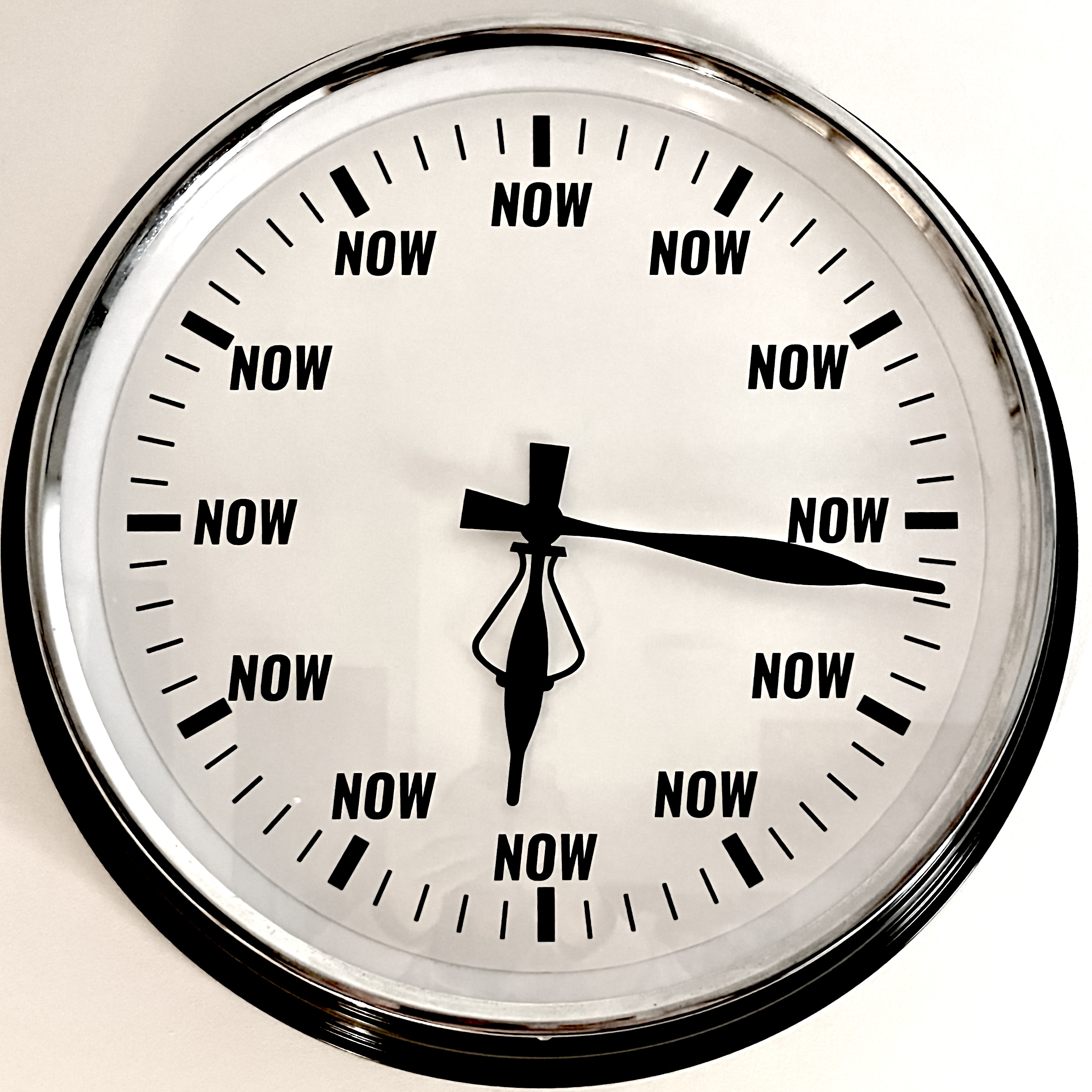
The Time is Now
Original Sculpture by Tim Ruth
£250.00
Out of stock
The Time Is Now continues Tim Ruth’s sustained investigation into the nature and measurement of time. Presented as a modified clock in which the present moment is perpetually indicated, the work confronts viewers with a simple yet inescapable proposition: time is not something approaching from the future or receding into the past — it is always occurring now.
This intervention emerges from the artist’s broader exploration of temporal structures, most notably in the large-scale painting An Explosion of Time, which examines the mathematical origins of contemporary timekeeping systems. Drawing on patterns found within the Fibonacci sequence, Ruth proposes that the familiar divisions of hours and minutes are not merely historical conventions, but reflections of deeper numerical order. In this context, the clock becomes less a tool of scheduling than a symbolic device — an interface between human perception and universal rhythm.
The Time Is Now translates this theoretical inquiry into an immediate experiential gesture. By altering the function of a clock — an object typically associated with delay, anticipation, and measurement — the artist redirects attention toward presence. The work operates as both reminder and provocation, encouraging a mode of awareness aligned with Ruth’s wider Hope-Free position: a refusal to become trapped in cycles of expectation or resignation.
To live in the present, the piece suggests, is not passive but radical. It requires relinquishing the psychological comfort of “later” — the belief that change can be deferred or responsibility postponed. In a world shaped by accelerating crises and systemic pressures, the insistence on immediacy becomes a form of resistance. Action, perception, and transformation are framed not as future possibilities but as conditions available only in the current moment.
The Time Is Now therefore extends beyond personal reflection. It gestures toward collective awakening, proposing that meaningful change begins with a shift in temporal consciousness. The work asks viewers to consider whether the greatest illusion of modern life is not the lack of time, but the persistent assumption that there will always be more of it.